SF Tech Week 2027: Dates & Founder's Guide
SF Tech Week 2027 runs October 4 to 10, closing a16z's four-city year. Here is the confirmed date, the platform change that breaks the old advice, the neighborhoods a16z tells its own hosts to use, and what to do before the calendar opens.
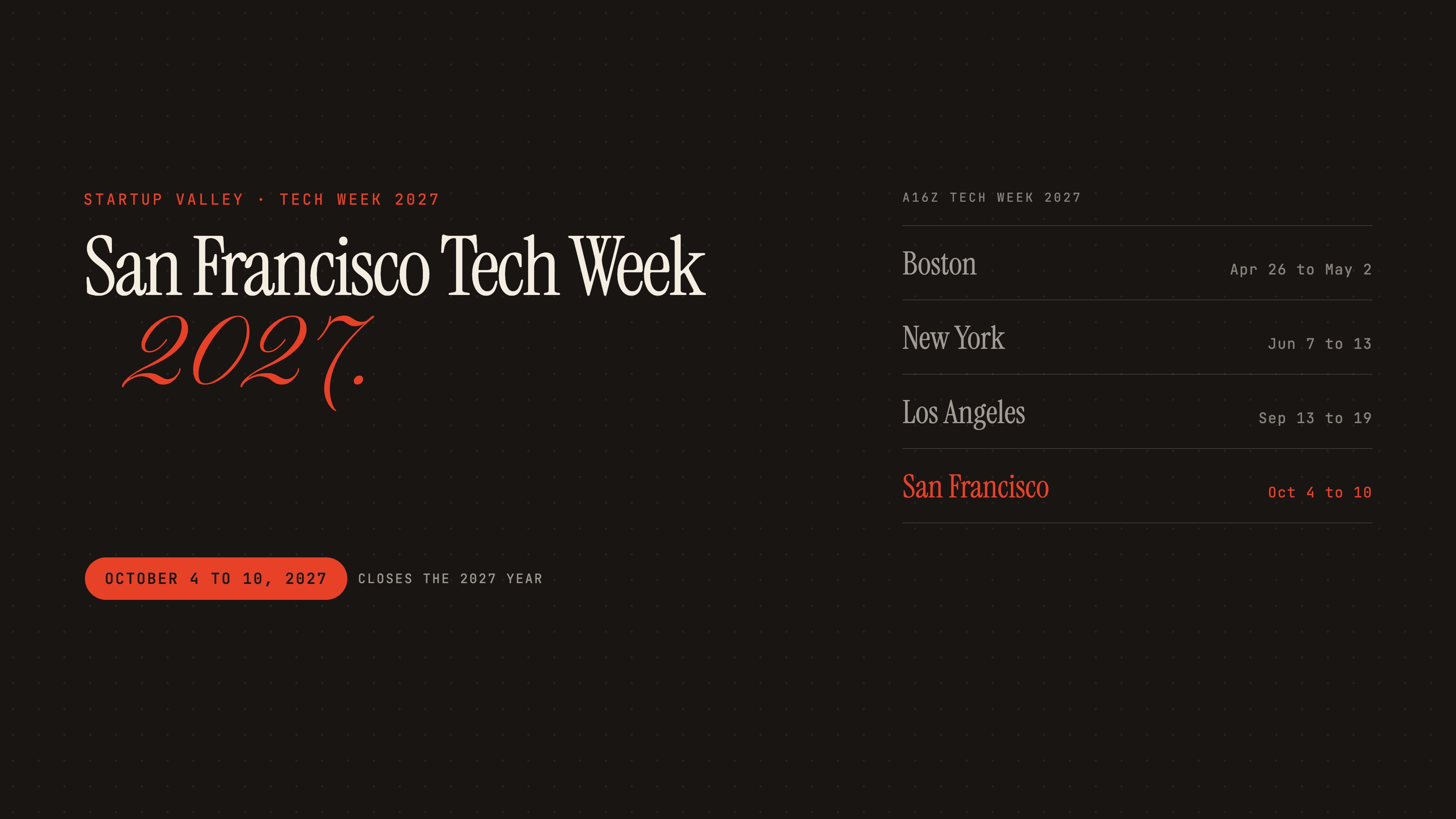
SF Tech Week 2027 runs October 4 to 10, 2027. a16z has published it on its San Francisco page, its homepage and its calendar page. As of November 2026 host submissions were not open, the calendar was not open, and nothing was listed.
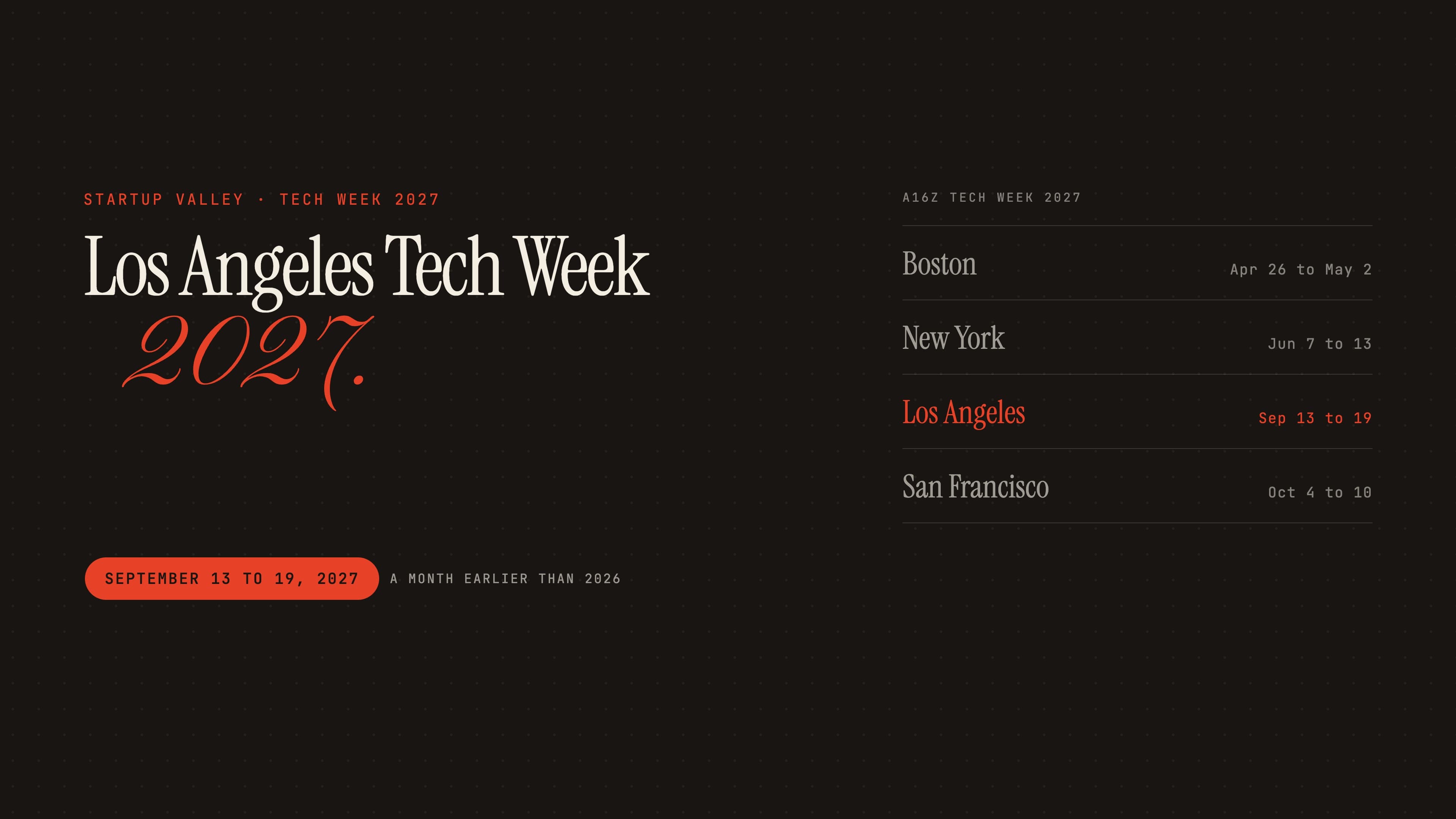
San Francisco goes last of the four cities in 2027, and it no longer sits beside Los Angeles. a16z puts it plainly in its own host FAQ, "LA now comes before SF, the reverse of 2026." The two are three weeks apart, so the back-to-back West Coast trip that worked in 2026 does not work in 2027.
When is SF Tech Week 2027?
October 4 to 10, 2027. San Francisco keeps its early-October slot, which it also held in 2026 when the week ran October 5 to 11. It is the fourth and final a16z Tech Week of the year.
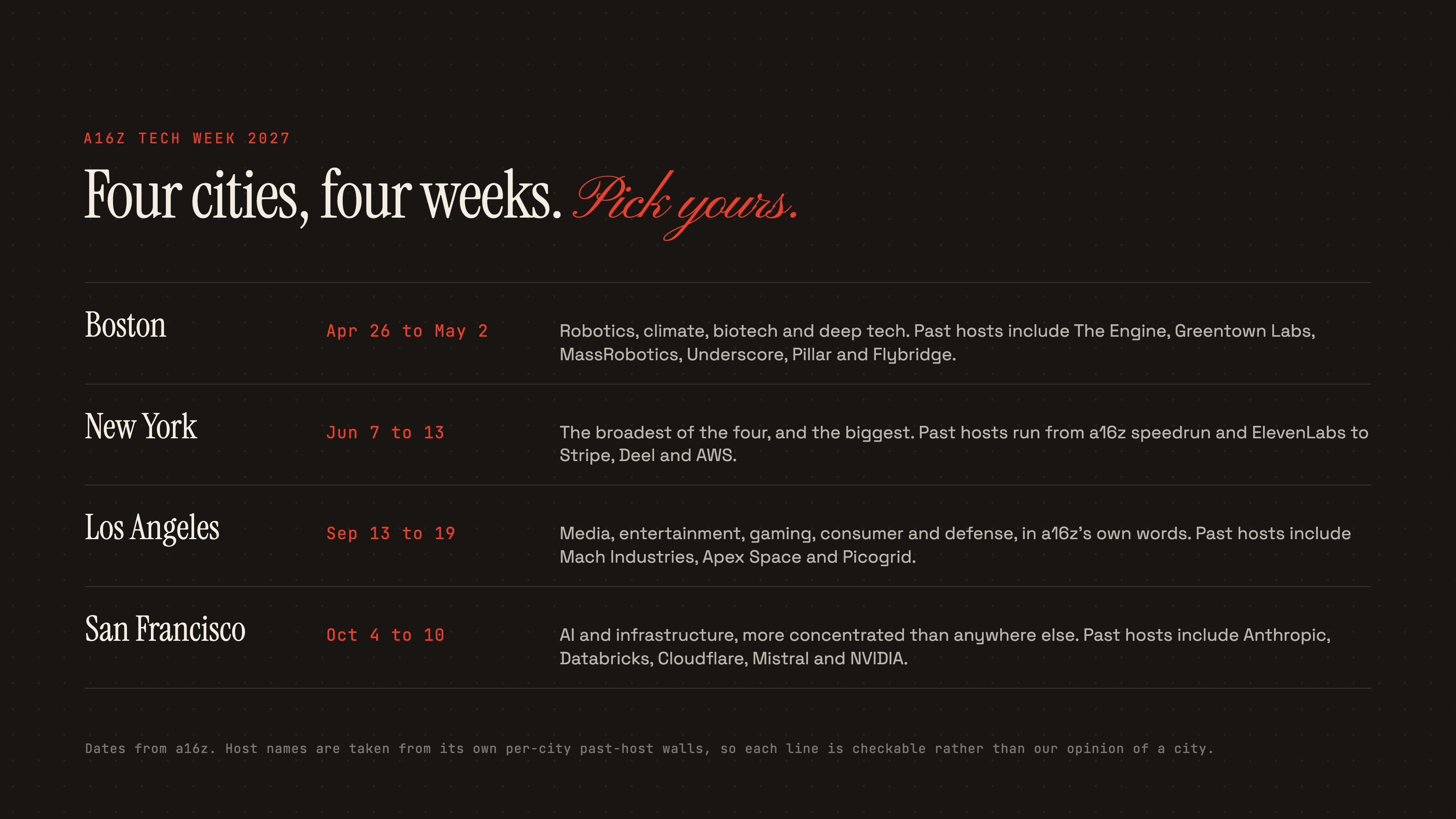
| City | 2027 dates | Order |
|---|---|---|
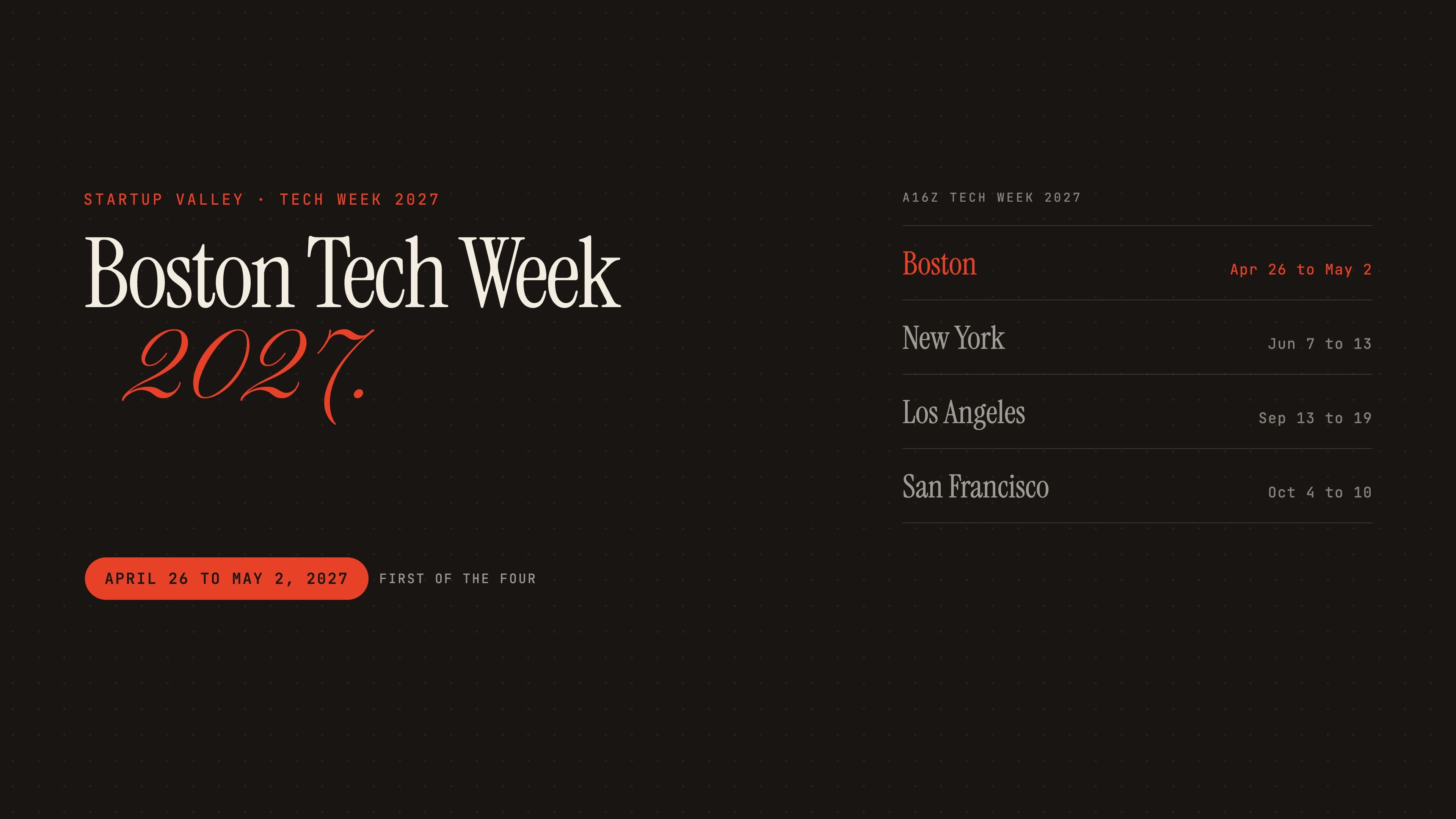
| Boston | April 26 to May 2 | 1st |
| New York | June 7 to 13 | 2nd |
| Los Angeles | September 13 to 19 | 3rd |
| San Francisco | October 4 to 10 | 4th |
"OCP Global Summit takes Moscone from October 4 to 7, the opening four days of Tech Week, in the biggest venue in the city. Book a bed before you have a calendar to plan around."
What changed for 2027
The place you register. For 2026 the answer was luma.com/sftw, and plenty of guides written then still say so. For 2027 the official listings move to Partiful.
a16z has also closed public access to its 2026 calendars, which now sit behind an email and password gate. The browsable record of who hosted what in 2026 is gone, so save anything you were planning from.
One trap survives from the 2026 week and is worth defusing. sf-techweek.com is not the official site. The official domain is tech-week.com.
What to expect again in 2027
Three editions of the archive show which hosts keep coming back, and that is the only honest way to predict a calendar before it opens.
Running in all three years. Hustle Fund (summits, office hours, a founders' mixer), The AI Collective (dinners, demo nights, hackathons), Bulletpitch's founder and investor dinner, Entre's founder-and-VC social, the Czech and Slovak edition, and a tech comedy show called Artificially Unintelligent that has run every year.
The venue that matters most is Frontier Tower at 995 Market Street, a sixteen-floor building that ran six events across the last two editions and says it hosts more than three a day year round. If you only learn one address, learn that one.
Formats are moving. Hackathons went from 5 to 4 to 12 across the three editions and are the fastest-growing thing in the week. Sport as networking went 4, 0, 8: bowling, padel, boxing, table tennis. Private dinners hit 22 in a single week. And office hours have died, from 4 events to 1 to none, so do not plan around them.
The fixtures to watch for are a kickoff party (Shack15 at the Ferry Building, with Cerebral Valley, in 2026), a closing party, a morning run, and a founders' breakfast. None of them is the same event each year, but one of each always exists.
How Tech Week actually works
No central venue, no wristband, no single ticket. a16z describes it as an unconference, meaning community-created events across the city for seven days, with a16z running the submission process, the shared calendar and the promotion.
You apply to each event separately and each host approves you individually. Hosts are told to respond within seven days, and that rejected applicants are not notified automatically, so no answer often means no.
The planning number that matters. a16z tells hosts that free Tech Week events "regularly see 50 to 70%+ no-shows" and to approve about 2.5 to 3 times their target. Apply widely, and do not assume a late application is wasted.
The week has a shape, and it is Tuesday to Thursday
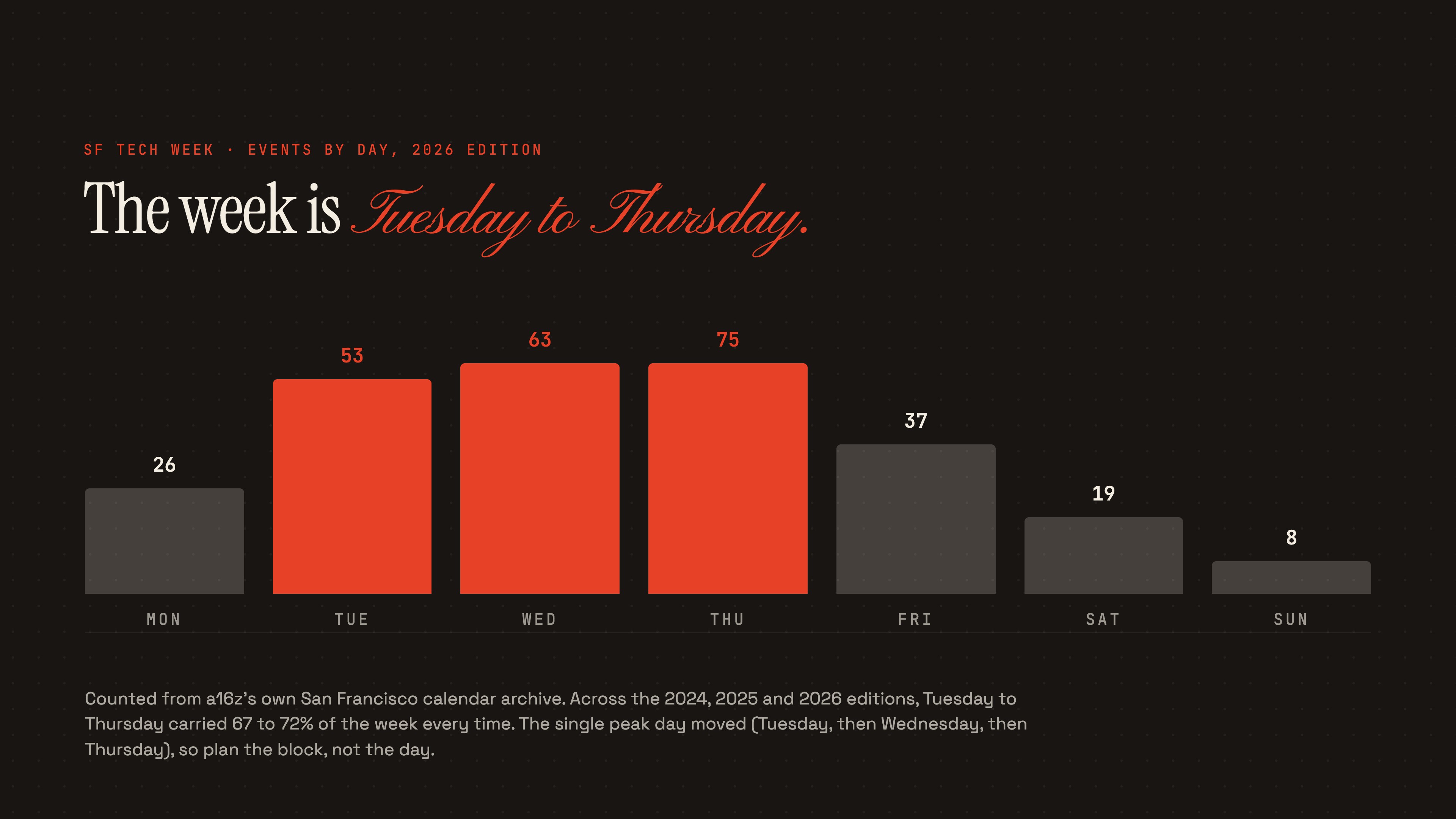
We counted every event in a16z's own San Francisco calendar archive, by the day it started, across three editions. The curve is steep and it should decide your flights.
Tuesday to Thursday carried 67 to 72% of the week in every one of the last three editions. Monday is a ramp at about 10%, and the weekend is 7 to 11% between the two days. The single busiest day moved each year, Tuesday in 2024, Wednesday in 2025, Thursday in 2026, so plan the block rather than the day. A trip that lands Monday evening and leaves Friday morning catches essentially all of it.
Treat the numbers as a floor rather than a total, because plenty of events never reach the official calendar at all. The shape is what matters, and the shape is unlikely to change for 2027.
The thing that breaks a plan, and the thing that fixes it
More than half the week does not tell you where it is. 158 of 280 events in 2026 hid the street address until the host approved you, showing only a neighborhood. a16z instructs hosts to do this. The consequence is that you cannot build a route from the public calendar, which is the real reason to get applications in rather than browsing on the day.
The fix is one a16z published and almost nobody uses. It runs an endpoint at tech-week.com/mcp so you can point Claude or ChatGPT at the official calendar and have it plan around your flights. Its own suggested prompt is close to what you want. Tell it when you land and when you leave, and ask it to fill the gaps.
The events are smaller than the listings suggest. Of the events that published a count, the median was 126 registered and the mean 186. Apply a16z's own 42% show rate and a "300 going" badge is a room of about 125. That is a good thing, and it is the argument for the 40-person workshop over the 600-person party.
Where to stay, and why a16z's own advice is half wrong
a16z tells hosts to pick SoMa and the Mission, the Financial District, or the Marina. Three of those four are right. We counted its own 2026 San Francisco calendar and the fourth is not.
The Marina produced 3 events out of 280. SoMa took 41, the Financial District 37, Union Square 26 and the Mission 16. Add Yerba Buena, South Beach and Rincon Hill and half the week sat within a short walk of Market Street between 2nd and 8th. The Marina is also the only neighborhood on a16z's list with no BART station and no Muni Metro line.
So stay in SoMa, the Financial District or around Union Square. The Mission is a genuine second cluster and a better evening, but it is a train ride from the daytime events rather than a walk.
270 of those 280 events were in San Francisco proper. The whole peninsula tail was three in Alameda, two in Menlo Park, one in Millbrae and one in Palo Alto. a16z tells hosts to avoid the South Bay and they listen. You do not need a car and you should not rent one.
| Neighborhood | 2026 events | Read |
|---|---|---|
| SoMa | 41 | The center of gravity |
| Financial District | 37 | Daytime and happy hours |
| Union Square | 26 | Inflated by a conference that co-landed |
| Mission | 16 | Best evenings, a train away |
| Marina | 3 | a16z suggests it. The calendar does not |
Where SF Tech Week actually happens
a16z gives its hosts an explicit map for San Francisco. It is SoMa and the Mission, the Financial District, and the Marina, and it tells them to "avoid the East Bay, South Bay and Peninsula when possible".
That is more useful than it looks. It means the week is a walkable and rideshare-short set of neighborhoods, and that a Palo Alto or Mountain View event during Tech Week is the exception rather than the pattern. If you are booking a place to stay, those four areas are the week.
The reasoning a16z gives is attendance. Central clusters produce "stronger density, better attendance, and lower attrition". Hosts are optimizing for people actually turning up, and you can use the same logic in reverse when you choose which events to apply to.
The 2026 calendar bore that out. Counting every listing on a16z's own San Francisco calendar for the week of October 5 to 11, SoMa led with 41, then the Financial District with 37, Union Square with 27 and the Mission with 16. Only ten of those listings sat outside San Francisco proper, split between Alameda, Menlo Park, Millbrae and Palo Alto. That is our count of their listings rather than a figure a16z publishes, and it is a floor, because plenty of events never reach the official calendar at all. The shape is the point. The week is a city week, not a Bay Area one.
October in San Francisco is warmer than July
This catches people every year. September and October are San Francisco's two warmest months. NOAA's normals for the downtown station put October at a 70F high and a 54F low, against July's 66F high. The fog that defines a San Francisco summer is gone by then.
For the Tech Week window specifically the normal high is 70F every day, the normal low is 55F, and the chance of rain on any given day is under one in ten. Pack one warm layer for an evening on the Embarcadero, where the wind is real, and leave the rain gear at home.
What the week costs, and the squeeze on the beds
The events are nearly all free. 260 of 280 in 2026, or 93%. The paid tail ran from $10 to $995, with most under $100. Budget for travel and coffee, not for tickets.
The beds are the expense, and the number is startling. CoStar measured the week of Tech Week 2026 and San Francisco was the top performer of the 25 largest US hotel markets, at 88.5% occupancy and an average daily rate of $274, against a 69% occupancy projection for the year. The week after, rates fell more than 20%. Tech Week and Fleet Week together did that, and in 2027 a 15,000-person hardware summit is landing on the same days.
Getting around is cheap. BART from SFO to downtown is $11.80 and about 30 minutes, and Oakland is $13.45 with a transfer, so SFO is the simpler arrival. Inside the city, Muni is $2.85 a ride with a Clipper card and a tap covers 120 minutes. A 7-day Visitor Passport is $47, which beats paying per ride at about 17 journeys, and it covers cable cars where a single ride is $9. BART is not included in any of that.
A SoMa coffee at Sightglass on 7th Street runs $5.25 for drip and $7.25 for a latte. A co-working day pass in the city sits somewhere around $45 to $60 downtown, though almost nobody publishes a rate you can check.
We are not printing a hotel range for October 2027. Rates that far out are not meaningful, and the honest guidance is the one fact above. This is the most expensive week of San Francisco's year and the 2027 edition has more competition for rooms than the one we measured.
What people who went actually say
The first-hand accounts disagree about almost everything except one thing, which is that nobody wishes they had done more events.
"Pick one or two events a day, max" is the sharpest version, from a founder writing during the 2026 week. "Choose small rooms over big parties. A 40-person workshop beats a 600-person afterparty." Another attendee put the same thought as a test. She would rather leave with two or three real conversations than twenty LinkedIn connections she could not place.
On what gets you in, the same writer is specific and it matches a16z's mechanics exactly. "Fill in the RSVP form properly. Hosts read it. One line on what you're building gets you approved more often than a blank field."
On what to skip, the bluntest line we found came from a recruiter who has worked the week for years. Do not waste time on lower-tier fund events and talks by people who have not built anything. The structural version of that advice is in the numbers. AI is tagged on more than half the calendar and panels are the second most common format, so the broad AI panel is the single most crowded and least distinctive room in the city that week.
What else is on in San Francisco that week
Two collisions are already on the board. OCP Global Summit runs October 4 to 7, 2027 at the Moscone Center. OCP says only that the summit is moving to a new location. Every previous one was in San Jose, Santa Clara, Palo Alto, New York or San Antonio, so as far as we can tell this is its first San Francisco edition. That is the opening four days of Tech Week, in the largest venue in the city, pulling a data-center and infrastructure crowd into the same hotels. If you are booking a bed for Tech Week 2027, this is the reason to do it early rather than a vague warning about San Francisco prices.
Two more sit either side of the week and are worth knowing before you build a trip around any of them.
A warning on everything else you will read. Aggregators are already listing TechCrunch Disrupt, Microsoft Ignite and OpenAI DevDay with 2027 San Francisco dates. We checked each organizer, and as of November 2026 none had published a 2027 date. Those listings are pattern guesses from last year's calendar, which is exactly the failure this guide exists to avoid.
| Event | 2027 dates | Where |
|---|---|---|
| OCP Global Summit | October 4 to 7 | Moscone Center, inside the week |
| Dreamforce | September 21 to 23 | San Francisco, two weeks before |
| The AI Conference | October 12 to 14 | San Francisco, the week after |
What to do before the calendar opens
Four things, in order of how much they are worth.
Leave your email on a16z's own [San Francisco page](https://www.tech-week.com/sf). It is the only channel that will tell you the day the calendar opens. Most good events are filled from the hosts' own lists, so the accounts you follow matter more than the calendar page.
Follow the hosts, not the calendar. The national names run something in every city. Anthropic, Databricks, Stripe, Google, AWS, Adobe, Atlassian, HubSpot, Eleven Labs and Deel all did. The funds and local companies you care about will announce to their own lists before anything hits a shared calendar.
Book a bed early if you are flying in. San Francisco in early October is already the most expensive week of the local calendar, and 2027 has no LA week beside it to spread demand.
Have something to show. The single biggest difference between founders who get value from Tech Week and founders who collect lanyards is whether they arrive with a sharp two-minute version of what they are building. That is a thing you can practice on a real audience before October, which is the one part of this we can help with directly.
SF Tech Week 2027 FAQ
When is SF Tech Week 2027?
October 4 to 10, 2027, confirmed on a16z's own pages. San Francisco closes the 2027 Tech Week year.
Is SF Tech Week free?
There is nothing to buy centrally. Hosts set their own terms and most events are free, which is why hosts deliberately over-approve.
Where do I register for 2027?
Per event, with the official listings on Partiful for 2027. Until the calendar opens, the notify form on a16z's SF page is the only live step.
Does it cost anything to host an event?
No. a16z states that it does not charge hosts to submit an event or to appear on the official calendar, and that there is no required paid sponsorship package to host a community event. You cover your own venue and catering.
Is SF Tech Week the same week as LA in 2027?
No, and this is the change most likely to catch people out. The two ran back to back in 2026. In 2027 they are three weeks apart, so a single West Coast trip no longer covers both.
Can I pitch at SF Tech Week?
At most Tech Week events, no. The stages that exist are mostly invite-only or fund-run. At ours, yes. We ran two San Francisco nights inside the 2026 week, one of them on the official calendar before the marquee hosts had posted anything, and we intend to be there again for October 4 to 10, 2027. That date is not published yet because the 2027 schedule is not set that far out. It will appear on our San Francisco page when it is, and pitch applications are open the whole time. Next San Francisco dates: Nov 4, Nov 25 and Dec 16.
San Francisco the rest of the year
Tech Week is seven days in October. The rest of the year is the part we run. 79 San Francisco nights so far, with more than 5,000 people through them, on a steady rhythm rather than once a year.
About five minutes of pitch from your own laptop, two or three minutes of live investor Q&A, networking before and after. Next San Francisco dates: Nov 4, Nov 25 and Dec 16, with the full schedule on our San Francisco page. For the record of how the 2026 week was built, including the host wall and the registration mechanics, our SF Tech Week 2026 guide still holds it.
Next San Francisco dates: Nov 4, Nov 25 and Dec 16. A 5-minute pitch, 2-3 minutes of live investor Q&A, and networking before and after.