The Pitch Guide: How to Pitch at a Startup Valley Night
Five minutes on stage, a PDF of about 8 slides, your goal in the first sentence and your ask in the last. This is the guide we send every founder who pitches at a Startup Valley night. Read the section you need, then go practice out loud.

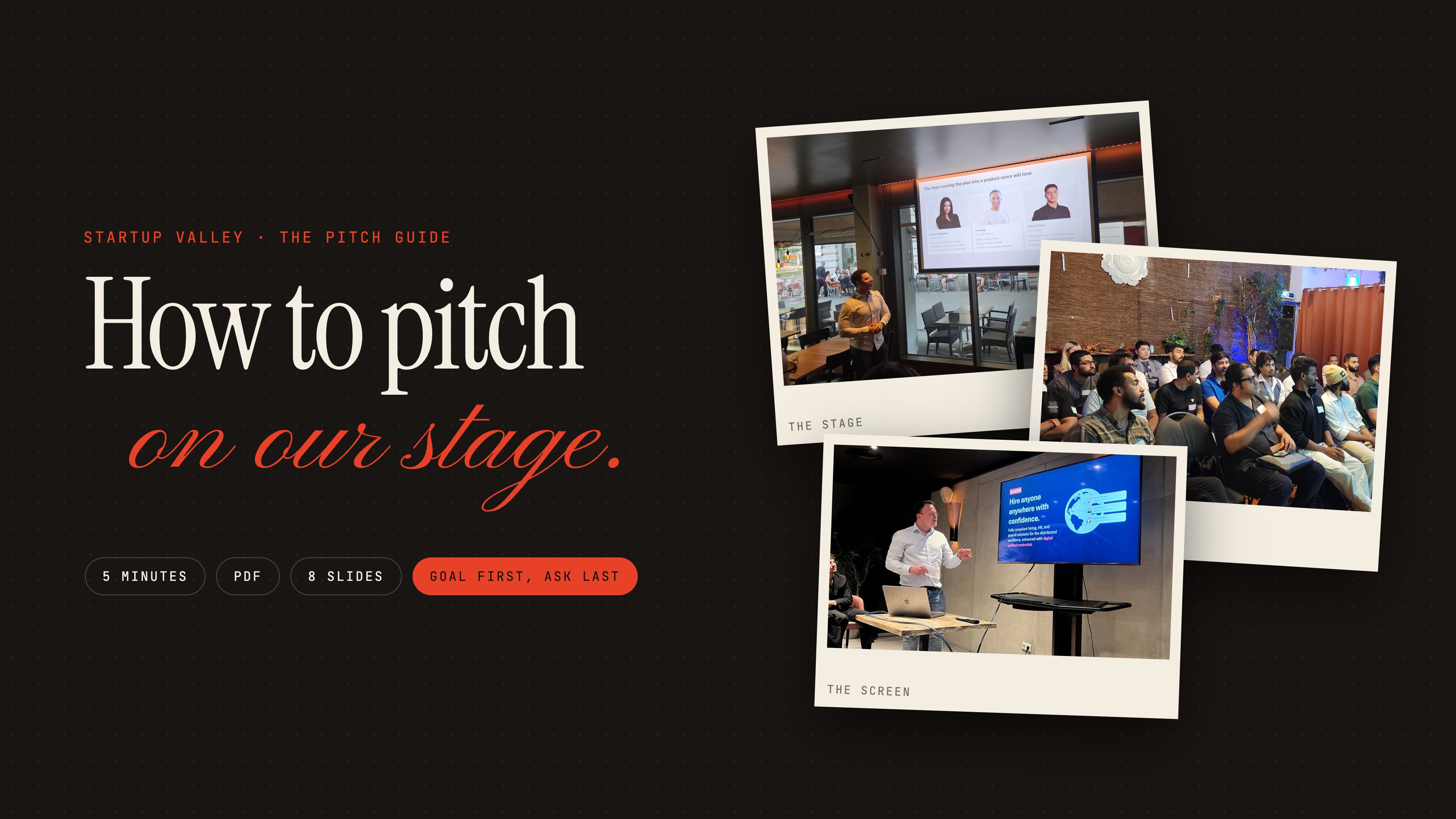
You have a pitch ticket. Here is everything that matters.
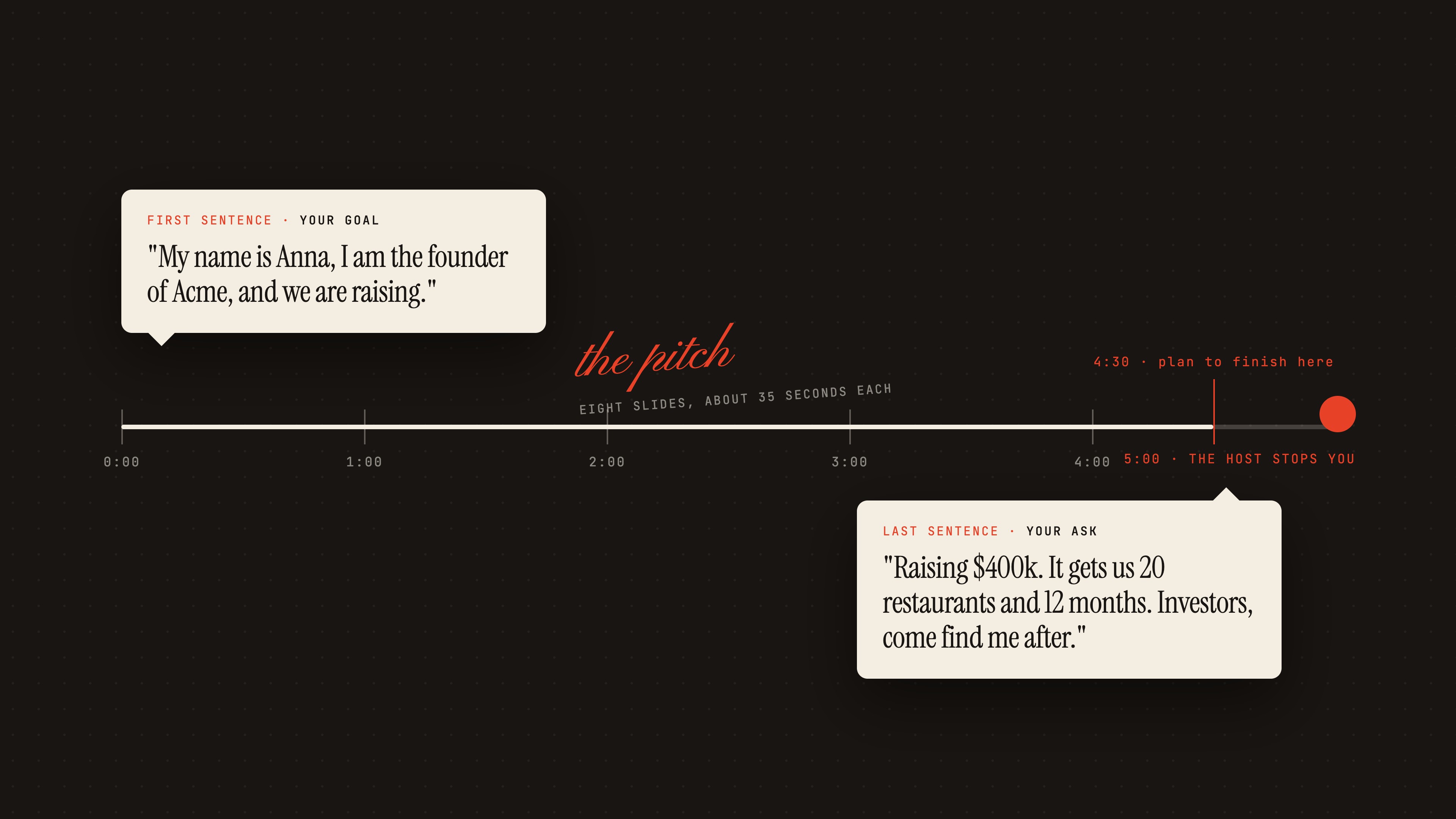
Your pitch is 5 minutes. Then about 3 minutes of questions from the room. The host stops you at five.
Say your goal in your first sentence. "We are raising." "I am looking for feedback." "We are looking for customers." The room decides in the first 20 seconds whether this pitch is for them.
Make your ask in your last sentence. The amount and what it buys, the questions you want answered, or the offer to the room. Then stop.
Send a PDF. About 8 slides, 10 at most. A PDF looks the same on every screen. PowerPoint, Keynote, Canva and Google Slides do not.
No live demo. Videos play in the background. If a video has to be in the pitch, it runs behind you while you keep talking.
Practice out loud a few times, with a timer. Be loud, be clear, be confident. A quiet pitch is a wasted pitch.
Doors open about an hour before the pitches. Come at doors, find the host, check your deck on the screen.
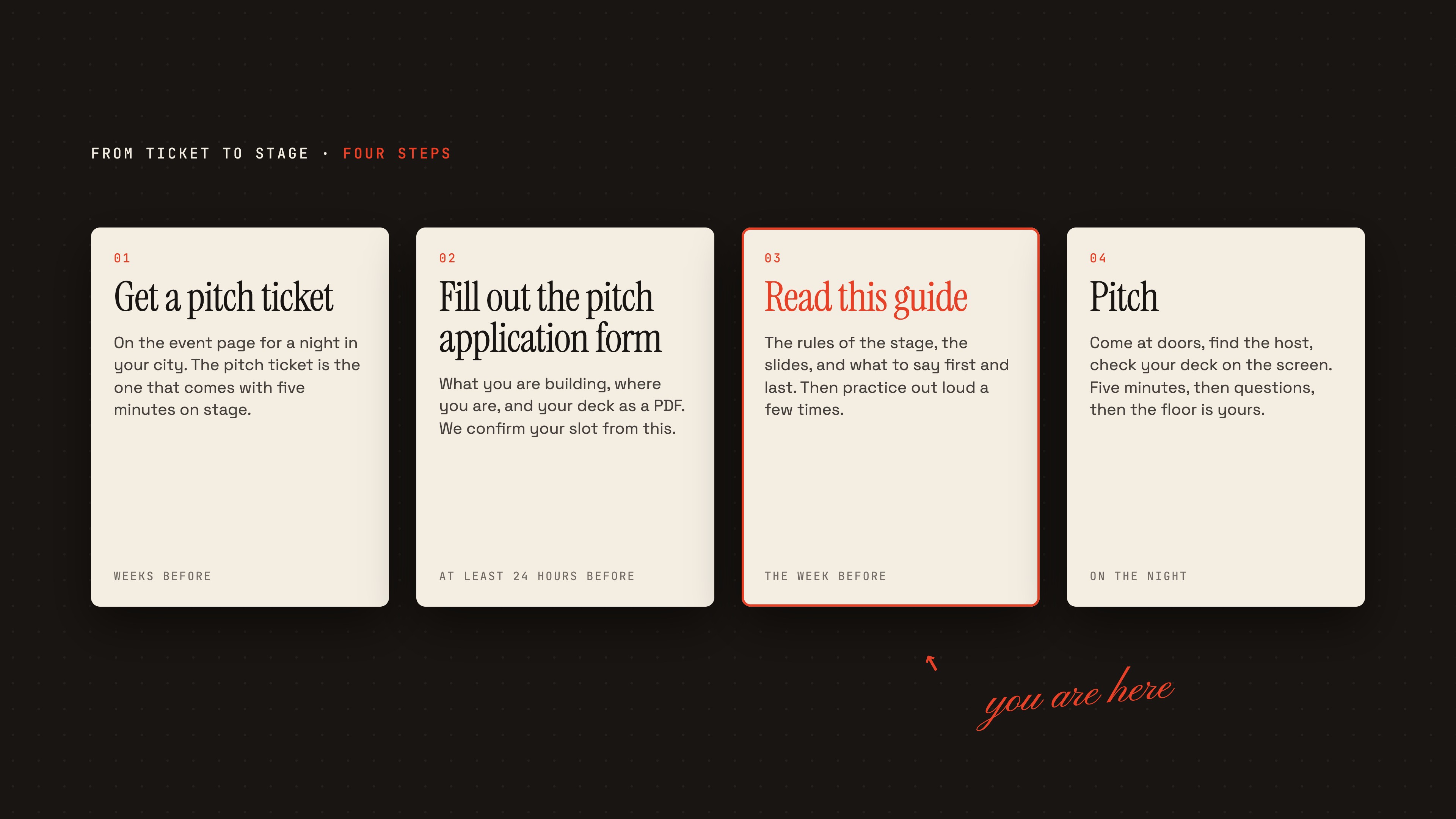
From ticket to stage
Here is the process. Please make sure you have filled out the pitch application form. It is how we confirm your slot and get your PDF onto the screen.
"Say why you are on stage in your first sentence. Make your ask in your last."
Your goal for the night
The most important thing at a pitch night is to say why you are on stage, and to say it in your first sentence. We have watched hundreds of founders pitch, and the most common mistake is not a bad slide. It is a founder who talks for five minutes and never says what they want from the night. The room does not know whether to open a checkbook, give advice, or sign up. So it does none of the three.
Say it in your first sentence
Your first sentence is your name, your company, and your goal. Like this.
"My name is Anna, I am the founder of Acme, and we are raising."
"My name is Anna, I am the founder of Acme, and I am here for feedback. We launched six weeks ago."
"My name is Anna, I am the founder of Acme, and we are looking for customers."
A pitch night is a mixed room. Investors, operators and future customers sit next to each other, and each of them decides in the first 20 seconds whether this pitch is for them.
The three goals
Pick one. Each goal changes who listens, what they need to hear, and what you ask for at the end.
| Goal and first sentence | Who listens, what they need | Closing ask |
|---|---|---|
| Raise. "We are raising." | Investors. They need traction, the market, the team, and the round. | "Raising $400k. It gets us 20 restaurants and 12 months. Investors, come find me after." |
| Get feedback. "I am here for feedback." | Operators, people who have run a company or a team. They need the problem, what you have tried, and what you do not know yet. | "Two questions for this room. Is $49 a month the right price, and would you buy this before the mobile app exists?" |
| Find customers. "We are looking for customers." | The people in the room who have the problem. They need the product, the price, and the result for a customer like them. | "If you run a team of 5 to 50 people, come find me. I have ten pilot spots." |
One goal, not three
A mixed goal is no goal. "We are raising, and we are looking for partners, and also customers, and advisors" means the room hears nothing and nobody comes to find you. If you really want two things, say the main one on stage and keep the second for the networking.
The goal also decides what the deck looks like. Raising means traction, market and team get the time. Feedback means the problem and the open questions get the time. Customers means the product and the price get the time. The deck below is the raising version, and the section after it says what to cut for the other two.
How the night runs
A Startup Valley night runs for about three hours. The exact times for your night are on the event page.
The timeline
| When | What happens | What you do |
|---|---|---|
| Doors open | Check-in, drinks, the room fills | Come at doors, not later. Check in, tell the host you are pitching, look at your deck on the screen for ten seconds. |
| The first hour | Open networking | The best networking of the night. The people who will hear your pitch are right there. Say your one line to ten of them. |
| About an hour after doors | The host opens the pitch session | The host calls founders up one by one. Have your first sentence ready. |
| Your five minutes | You pitch, the host keeps time | Goal in the first sentence, ask in the last. At five minutes the host stops you, wherever you are. Plan for four and a half. |
| About three minutes | Questions from the room | Two or three questions, usually from investors and operators. Short answers. |
| After the last pitch | The floor opens until close | This is where the pitch pays off. People who liked it come to you. Stay until the end. |
The order and the clock
The order of pitches is decided on the night. If you want to go first, ask the host at check-in. Going first means the room is fresh. Going last means they remember you in the networking after.
The clock is not flexible. At five minutes the host stops you, every night, every founder. If the ask is on slide 8 and you are on slide 6, the room never hears it. That is why you plan for four and a half, and why the goal goes in the first sentence, where nothing can cut it.
Whatever gets asked first in the Q&A is the thing your pitch did not settle. We wrote up what investors look for in a five-minute pitch, including what they tend to ask.
The deck
About 8 slides, as a PDF, in the order below. It is the order investors expect, the same one the Sequoia and Antler guides recommend, cut down to what fits in five minutes on a stage at night rather than twenty in a boardroom. Every slide you drop gives the others more time.
The math
A five-minute pitch is 300 seconds, and you plan for 270 so the host never stops you before your ask. The title slide takes 20 seconds. The other seven share the rest, about 35 seconds each, which is 60 to 80 spoken words. Count the words in your script. If a slide needs 150 words, it is two slides, or the words have to go. With 10 slides each one gets about 25 seconds. With 15 you are reading, not pitching, and the host stops you on slide 11. So aim for 8, and never go past 10.
The slides to include
Eight slides, in this order. Many founders leave out the team slide. Do not. At pre-seed the team is most of what an investor is buying, and it is the first thing they ask about when it is missing.
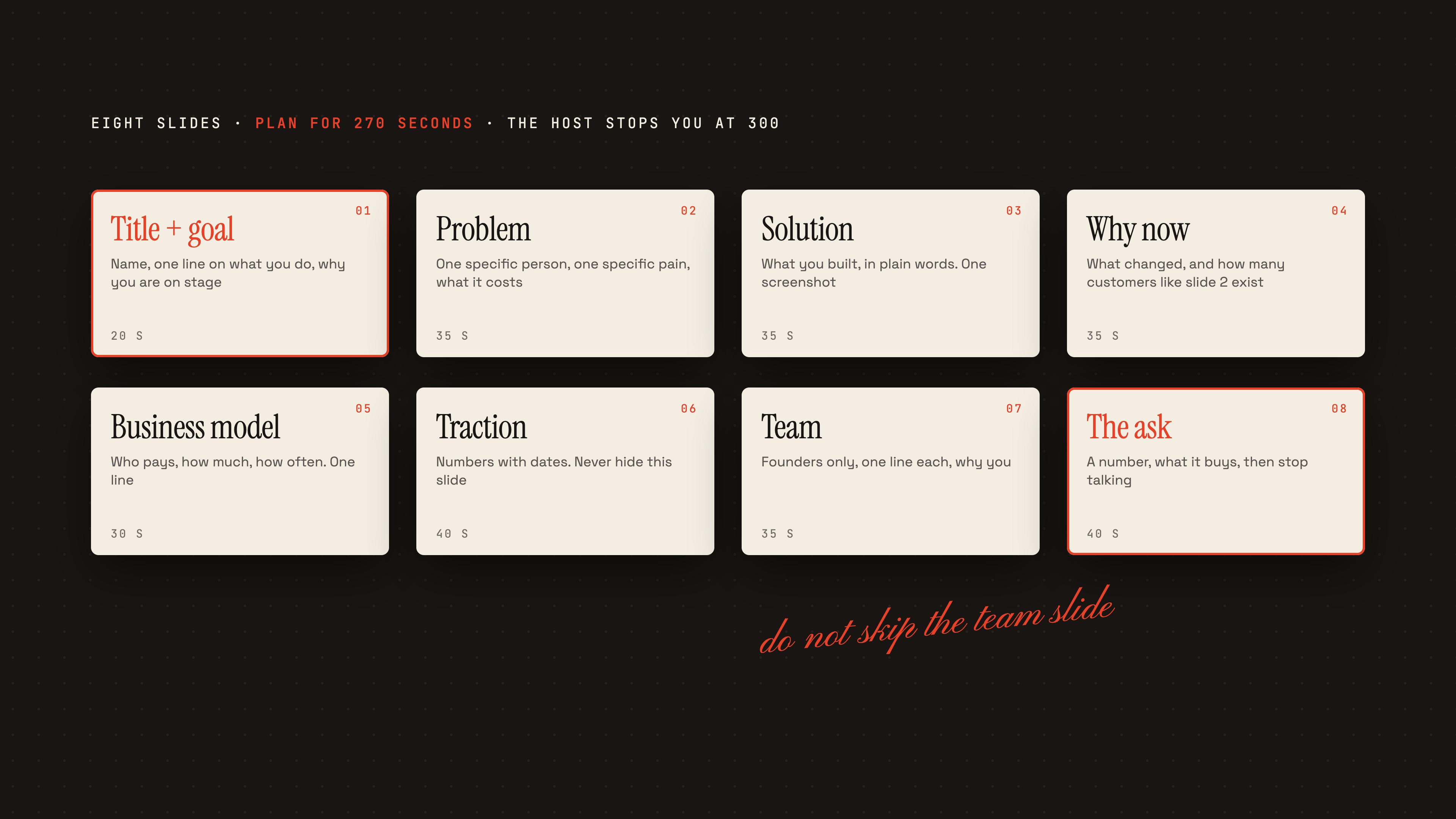
| # | Slide | What goes on it | Time |
|---|---|---|---|
| 1 | Title and goal | Company name, one plain sentence on what you do, and your goal for the night. "Acme. Payroll for restaurants. We are raising." If a stranger cannot repeat your one line after hearing it once, rewrite it. | 20 s |
| 2 | Problem | One specific person with one specific pain, and what it costs them today. "A three-person plumbing company loses an evening a week chasing late payments" beats "SMBs waste time on invoicing". | 35 s |
| 3 | Solution | What you built and what it does for the person on slide 2, in plain words. One screenshot. No feature list. | 35 s |
| 4 | Why now, and the market | What changed so this is possible today and not five years ago. A new rule, a new model, a new behavior. Then how many customers like the one on slide 2 exist. Skip the trillion-dollar number. | 35 s |
| 5 | Business model | Who pays you, how much, how often. One line. "$49 per location per month." If you do not know yet, say your best guess and say it is a guess. | 30 s |
| 6 | Traction | Numbers with dates. Paying customers, revenue, users, signed pilots, a waitlist. If you have nothing yet, what you learned from 30 customer conversations. Never hide this slide. | 40 s |
| 7 | Team | Founders only, one line each, and why you are the people to solve this. Not your advisors. If you are solo, say how you cover what you cannot do yourself. | 35 s |
| 8 | The ask | The specific thing you want, with a number in it, and what it buys. "Raising $400k. It gets us 20 restaurants and 12 months. Investors, come find me after." Then stop talking. | 40 s |
Cut it for your goal
The table above is the raising deck. The other two goals need less.
| Goal | Keep | Drop or change | Slides |
|---|---|---|---|
| Raise | All eight | Nothing. If you have no numbers yet, slide 6 becomes what you learned from customers. | 8 |
| Get feedback | Title, problem, solution, business model, team | Drop why now and traction. Slide 8 becomes the two or three questions you want the room to answer. | 6 |
| Find customers | Title, problem, solution, business model | Drop why now, traction and team. Add one slide with a real customer's result. Slide 8 is the offer. Nobody buys because your market is big. | 5 |
Deck words, in plain English
Four words trip up first-time founders. Traction, round, TAM and valuation. Here is what each one means on a slide. Read this if you are an early-stage founder.
Format and the screen
Send your deck as a PDF, through the pitch application form, at least 24 hours before the night. Export it at 16:9. The host shows every deck from one laptop connected to the venue screen.
PDF only
A PDF has no fonts to miss, no links to load, no animations to wait for, so it looks the same on every screen. We have had PowerPoint decks lose their fonts on the night and Canva links wait on the venue Wi-Fi while the clock ran. A PDF export takes ten seconds in any tool.
Videos and demos
Videos play in the background. If a video has to be in your pitch, it runs behind you while you keep talking. You do not stop, press play, and watch it with the room. That is a minute gone from five. Keep it under 30 seconds, mute it, and tell the host before the session so it is ready. A video inside a PDF does not play, so send the file separately when you send the deck.
No live demo on stage. Venue Wi-Fi, a login screen and a loading spinner have ended more pitches than hard questions have. Put a screenshot on the solution slide. Show the live product in the networking after, on your own laptop, to the people who asked for it. Five minutes is for the business.
Type and words
The back row is 30 feet from the screen. 30-point text or larger, one idea per slide, under 20 words on it, no paragraphs. If the room can read faster than you talk, it reads ahead and stops listening. If a slide has to be read, it will not be.
Sending and updating the deck
Deadline. At least 24 hours before the night, through the pitch application form.
A newer version. Fill in the form again with the new PDF and we use the latest one. On the night, tell the host which version is right.
On stage
The pitches that work are loud, clear and practiced. Not polished. Practiced. A founder who has said the pitch out loud a few times does not read the slides, does not run over, and does not go quiet when the mic is handed over. Most founders we see have practiced zero times. It shows in the first thirty seconds.
Practice
Out loud, a few times, with a timer. In your head does not count. Standing up, at the volume of a loud room, with the phone timer running. The first run is always seven minutes. By the third it is five. After that you can lose a slide and keep going.
Say the first sentence to someone who knows nothing about your company. If they cannot repeat what you do and what you want, rewrite it before you touch another slide.
Voice and body
Be loud. Louder than feels normal. If the back of the room cannot hear you, it does not matter how good the startup is. They will not get it.
The screen is behind you and the audience is in front. Turn to read a slide and you turn away from the people you are talking to. Know what is on each slide so you never need to look.
Slow down on the numbers. Say your traction number, pause, say it again. It is the one thing the investor writes down. If you feel you are speaking too slowly, you are speaking at about the right speed.
Be confident in what you say. You know this company better than anyone in the room. Sound like it.
Finish on the ask. Not on "so yeah, that's it". Say the ask, say thank you, stop.
The Q&A
About three minutes, so two or three questions in total. Short answer first, then one sentence of context. If you do not know, say so.
Mistakes to avoid
Over the last 900+ pitch nights we have watched the same few mistakes come back, often from founders with great companies. We wrote them down so you can avoid them. None of them is about a bad idea, and all of them are fixable the week before.
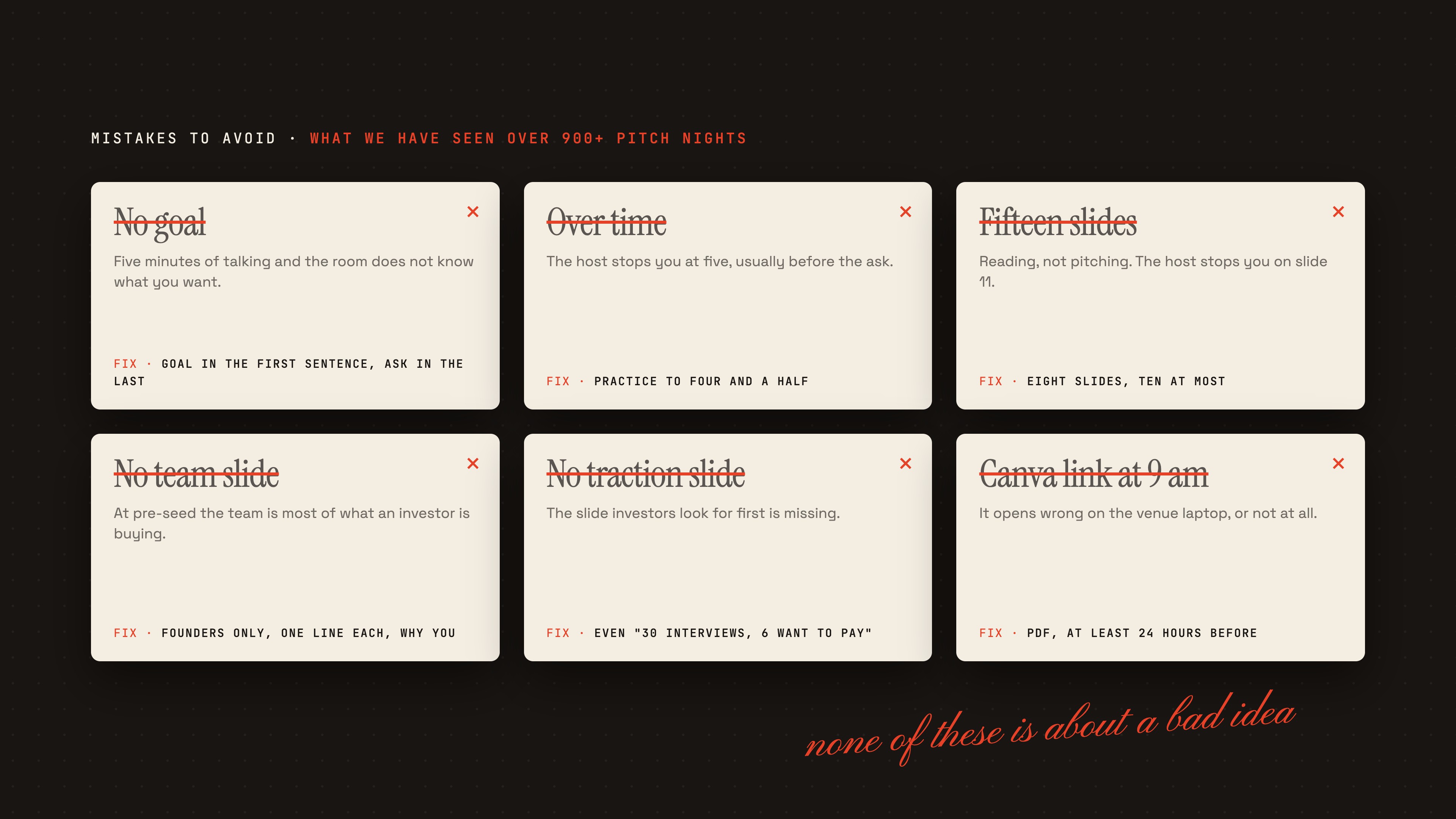
| Mistake | Fix |
|---|---|
| No goal. The founder talks for five minutes and the room does not know what they want. The most common mistake by far. | Say the goal in your first sentence. Make the ask in your last. |
| Over time. The host stops you at five minutes, usually before the ask. | Practice to four and a half. |
| Fifteen slides. Reading, not pitching. | Eight slides, ten at most. |
| No team slide. The thing an investor is buying at pre-seed is missing. | Founders only, one line each, why you. |
| No traction slide. The slide investors look for first is missing. | Even "30 interviews, 6 want to pay" is a traction slide. |
| The slide says Seed, the number says pre-seed. It will be the first question. | Someone who knows nothing about your company reads the deck once and tells you what they did not understand. |
| An ask the room cannot answer. "Raising $15M at a $150M valuation" at a pitch night. The investors in the room write pre-seed and seed checks. Nobody in it can act on that ask, so nobody does. | Match the ask to the room. If you are past seed, come for feedback or customers and say so in your first sentence. |
| "Raising 1.5" with no unit. $1.5M, or at a $1.5M valuation? | The amount, the round, and what it buys, in one sentence. |
| A six-minute demo video inside a five-minute pitch. | Under 30 seconds, in the background, muted. |
| A Canva or Google Slides link on the morning of the event. It opens wrong or not at all. | PDF, at least 24 hours before. |
| A quiet founder. Great idea, nobody heard it. | The section above. |
| Expecting a competition. There is no prize, no jury and no winner. | It is a working session. The strongest startups from every two weeks of nights get featured in our investor digest, which is worth more than a trophy. |
Questions pitchers ask us
How long is the pitch? Five minutes, then about three minutes of questions. The host stops you at five.
Do I pitch from my laptop or yours? The host has your PDF on the laptop connected to the screen. You do not need to bring anything.
PDF, PowerPoint, or a link? PDF. Only PDF.
How many slides? About 8. Ten is the ceiling.
When is the deadline for the deck? At least 24 hours before the night, through the pitch application form. Send a newer version through the same form and we use the latest one.
What time do I pitch? The pitch session starts about an hour after doors open. The order is decided on the night. Ask the host at check-in if you want to go first.
Who is in the audience? Founders, operators and local investors. We invite investors to every night. We do not promise who comes.
Can my co-founder pitch with me? Yes. Two of you can present together. Each person needs their own ticket, and one of you needs the pitch ticket.
Can I pitch remotely? No. Every night is in person. If you cannot make it, your ticket moves to any upcoming night in the same city. Reply to your confirmation email.
Will I get the investors' contacts after the night? No. Interested investors reach out to you, through the digest or on the night. The contacts you collect yourself in the networking are the ones that count.
Can I show a video or a live demo? A video in the background while you talk, under 30 seconds. No live demo on stage. Demo in the networking.
Can I pitch without a deck? Yes, if you must. A clear five minutes of talking beats a bad deck. But send a PDF if you have one. The room remembers what it sees.
Is there a prize? No. No jury, no winner. The best startups are featured in the investor digest and on our social channels.
Do you give feedback on my deck? Yes. Send it through the form, then reply to your welcome email with your questions. We tell you what to cut and what to lead with.
Does a Standard or Early Bird ticket let me pitch? No. Only the pitch ticket gets the five minutes on stage. If you bought another ticket and want to pitch, reply to your confirmation email and we will sort it out.
What language? English, in every city.
After you step down
The pitch is the opening move. People come to you in the networking after. Say the same one line, answer with the same detail you had on stage, and collect the follow-ups. Within 48 hours, send a short note to everyone who asked for the deck, and attach the long version. The shape of that note is in the cold intro that actually gets a reply.
Founders who pitch can be listed in our public startup directory, and the strongest go out in the investor digest every two weeks. The listing keeps working for months after the night. If you have not taken the stage yet, apply for a pitch slot at a night near you, send us the PDF, and come back to this page the week before.
Further reading
If you want to go deeper than five minutes on a stage, these are the guides worth your time. Written by people who have sat through thousands of pitches, and still the best reading on the subject. Read them when you have an evening, not the night before.
The classic outline. Its first rule is the one to keep. Define your company in a single declarative sentence.
The most complete pre-seed structure. Too long for five minutes, so use it to write the long version you email after the night.
Aaron Harris's template, simple by design. One slide per section where you can, three at most, and nobody cares about your advisors.
About words, not slides. Lead with what you do, not why or how. A great pitch is one you can tell to your mom and she gets it.
One point per slide, about seven words on it, and the room remembers three or four things at most. Stricter than us on video. He says never.
Say what you do in the first sentence and speak slower than feels right. He dropped live demos once stage talks got short.
Open with the name and what it does. Then write a two-sentence description, email it to a friend, and ask them to explain it back.
Take the font rule, not the time rule. Twenty minutes is four of our pitches.
Data on what investors actually read. You get five minutes live. Both mean cut hard.
Get a pitch ticket for a night in your city and send us your PDF.